 Online Asphalt Calculator
Asphalt vs Concrete Driveway Cost
The useful comparison is not one national asphalt number against one national concrete number. It is two local bids for the same measured area and stated scope. This guide shows what to align before you decide.
Start with comparable bids
Asphalt often has a lower initial bid than concrete, but broad published ranges overlap because they describe different sites, base preparation, thicknesses, finishes and removal work. A low figure for a favorable-site overlay is not comparable with a full removal and new-base installation.
| Put this on both bids | Why it changes the comparison |
|---|---|
| Measured paved area | A total price cannot be normalized when the contractors measured different footprints. |
| Removal and disposal | Tearing out an existing surface is a separate scope from paving over a prepared site. |
| Subgrade and aggregate base | Depth, repair and drainage work can move the project total more than the surface material. |
| Finished thickness and material specification | Compare compacted asphalt thickness with the stated concrete slab and reinforcement—not loose placement depth. |
| Finish, edges and joints | Plain concrete and decorative finishes are different products; asphalt edging and transitions also affect scope. |
| Delivery, tax, permits and minimum charges | Excluded charges can erase an apparent headline-price advantage. |
| Maintenance assumptions | Future sealing, crack repair, resurfacing and replacement are scenarios, not part of the initial bid. |
What the captured examples actually show
Two source pages were captured for the original version of this guide on September 14, 2026. They support only the claims visible in the captures; they do not establish one universal national price or a fixed percentage difference between materials.
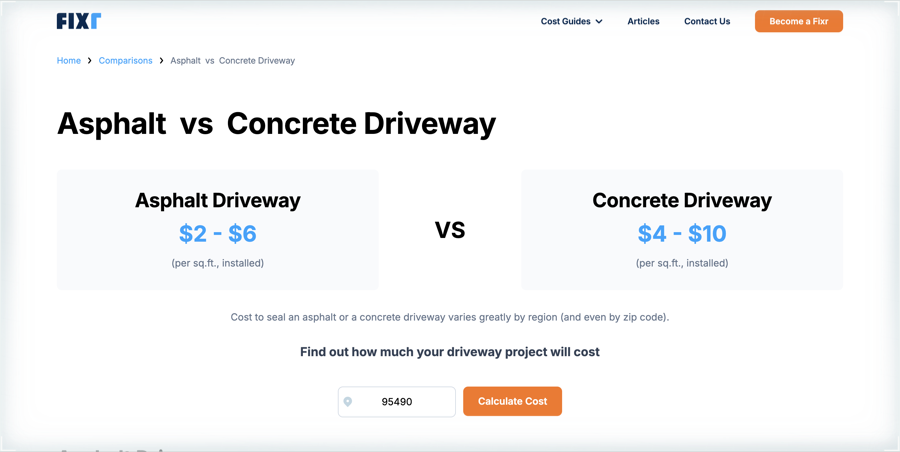
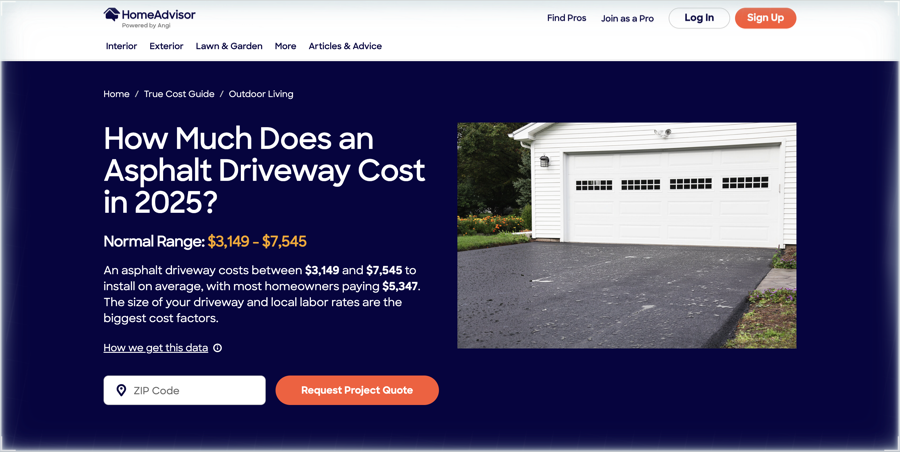
The earlier chart mixed one $7–$13 table entry with a $7–$15 chart label, so it has been removed. These two captures are retained because their displayed values, source context and limitations can be stated directly. Review the live source before treating either as current.
Use a scenario, not a promised 30-year winner
A lifecycle comparison depends on choices that are unknown before local inspection: initial scope, drainage and base condition, climate, traffic, sealing schedule, repair timing, whether asphalt can be overlaid, whether concrete needs isolated or full-depth repair, and how future costs are valued. Changing one of those assumptions can reverse the result.
| Scenario input | Asphalt option | Concrete option |
|---|---|---|
| Initial work | Use the itemized asphalt bid | Use the itemized concrete bid |
| Routine work | Enter only the sealing/repair schedule you intend to follow | Enter only the sealing/joint-repair schedule you intend to follow |
| Major future work | Model overlay and replacement as separate possibilities | Model repair and replacement as separate possibilities |
| Time basis | State whether figures are current dollars, inflated future dollars or discounted present values | |
The former 30-year example was arithmetically reproducible, but its fixed maintenance and overlay schedule was not a fact about every driveway. It has been removed rather than presented as proof that one material is usually cheaper to own.
Questions the price alone cannot answer
- Site condition: What subgrade, drainage or base correction is included after removal?
- Design: What finished section is proposed for the expected traffic and local conditions?
- Material: What mix, slab, reinforcement, finish and joint details are stated?
- Construction: How will access, transitions, compaction, curing and weather limits be handled?
- Future work: Which maintenance assumptions come from the contractor or manufacturer for this project?
These are scope questions, not engineering conclusions from this site. A local contractor or engineer must evaluate soil, drainage, loading, climate and applicable requirements.
Run and compare your own numbers
Estimate the asphalt option with the cost calculator →
- Material, delivery and installed inputs remain separate.
- You can start from dimensions, a known area or a quoted order quantity.
- Unknown charges remain visible instead of being treated as zero-cost work.
Check two asphalt bids on the same basis →
- Compare area, thickness, tons and scope.
- Use differences to generate questions rather than rate contractors.
FAQ
Is asphalt always cheaper than concrete?
No universal result applies to every site. The captured comparison above shows a lower asphalt range for that source and scope, but local base work, removal, finish, access and minimum charges can change either bid. Compare the same itemized scope.
Can I use a national cost per square foot as my budget?
Use a clearly dated range only as an early check. Your working budget should use your measured area and local, scope-matched quotes. Do not convert a project-total average to a per-square-foot price unless the area and included work are known.
Which material costs less over 30 years?
That depends on the initial bids and explicit repair, sealing, overlay, replacement, inflation and discount assumptions. A scenario can compare those inputs; it cannot guarantee the life or maintenance path of a particular driveway.
Further reading
- Material-only vs installed asphalt cost — align price scope before comparing.
- Asphalt thickness guide — understand the planning input and its limits.
- How to measure a driveway — establish the area both bids should use.