 Online Asphalt Calculator
How to Measure a Driveway for Asphalt
Square footage is the one number every asphalt estimate starts with. Here's how to measure any driveway — straight, L-shaped or curved — and get an area you can actually order from.
What you need
- A 100-ft tape measure, or a measuring wheel for long driveways
- Stakes and string (optional, for squaring off sections)
- Something to sketch and record with — paper or your phone
- A helper for the far end of the tape (a screwdriver in the ground works too)
Measure everything in feet. If you take a width in inches, divide by 12 before you write it down — mixing feet and inches is the most common way a measurement session goes wrong.
Step 1 — Sketch the shape and split it into sections
Draw the driveway roughly to scale and mark every part that will be paved: the main run, any parking pad or turnaround, the flare where it meets the garage, and the apron where it meets the street. Then divide the sketch into simple shapes — rectangles, triangles, circles — that each have a formula. Almost any driveway reduces to two or three of these.
Step 2 — Measure rectangles
For a straight rectangular driveway, take the length along the centerline and the width edge to edge:
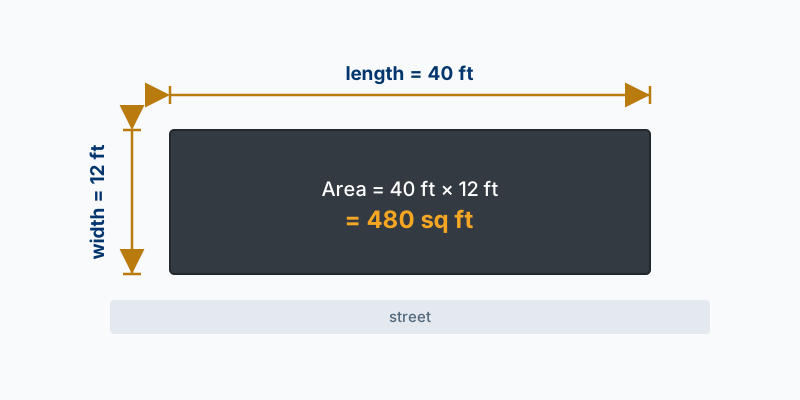
Measure the full paved footprint, not just the worn driving strip — you are ordering material for the whole surface.
Step 3 — Split L-shapes and irregular layouts
An L-shaped driveway is just two rectangles sharing an edge. Measure each rectangle on its own, then add the areas:
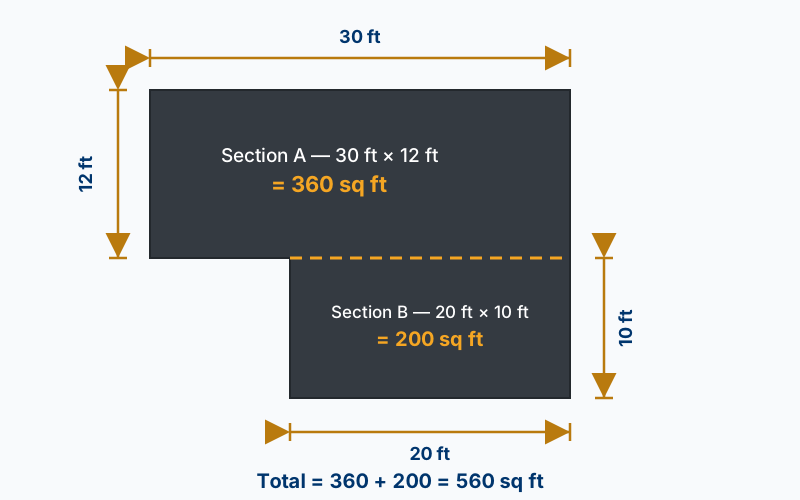
The same trick handles T-shapes, parking pads and garage flares. Keep one decimal place per section and round only at the end.
Step 4 — Handle curves with the average-width method
For a curved driveway, measure the length along the centerline (walk it with the tape or wheel), then measure the width at regular intervals — every 10 ft works well — and average the readings:
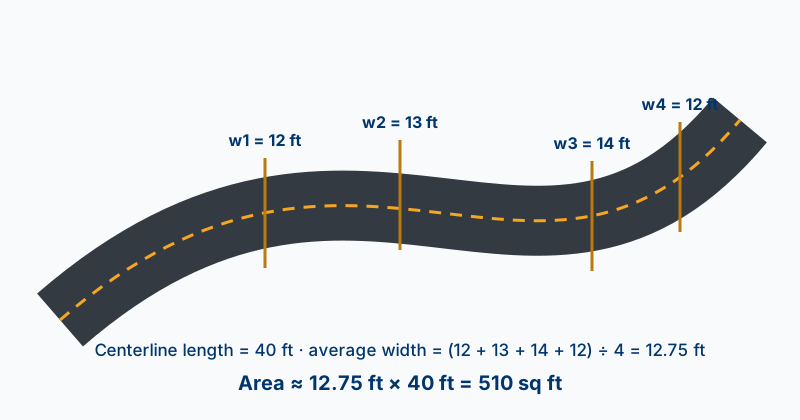
This is an approximation, and accuracy depends on how quickly the width changes and how closely you space the readings. Use more stations where the edges change direction, and ask the contractor to verify the measured area before ordering.
Shape formulas cheat sheet
| Shape | Formula | Example |
|---|---|---|
| Rectangle | L × W | 40 × 12 = 480 sq ft |
| Triangle (flare) | (base × height) ÷ 2 | (6 × 4) ÷ 2 = 12 sq ft |
| Circle (cul-de-sac) | π × r² | 3.1416 × 20² ≈ 1,257 sq ft |
| Half circle | (π × r²) ÷ 2 | 1,257 ÷ 2 ≈ 628 sq ft |
| Trapezoid (tapered drive) | (w₁ + w₂) ÷ 2 × L | (10 + 14) ÷ 2 × 30 = 360 sq ft |
Common measuring mistakes
- Measuring only the worn strip — order for the full edge-to-edge footprint, including the apron at the street.
- Mixing units — a 10 ft 6 in width is 10.5 ft, not 10.6 ft.
- Rounding each section — keep decimals until the final sum.
- Assuming both edges of a tapered driveway match — measure both ends and use the trapezoid formula.
- Skipping the small extras — a walkway flare or parking pad can add 5–10% to the total.
Does slope change the area?
Barely. Sloped pavement is longer than its horizontal footprint by a factor of √(1 + grade²) — but even a steep 20% grade adds only about 2% to the area. A tape or wheel following the surface already measures the sloped length; a plan or map may report horizontal distance, so record which method you used and let the contractor verify unusually steep sites.
From square feet to tons
Once you have the area, tonnage is a short calculation. At the standard 145 lb/ft³ planning density, every 100 sq ft needs about1.8 tons per 3 inches of compacted thickness. So the 560 sq ft L-shaped driveway above works out to:
| Net tons at 3 in | 560 ÷ 100 × 1.8 ≈ 10.1 tons |
| Order quantity (+5% waste) | 10.1 × 1.05 ≈ 10.6 tons |
The full formula and a per-100-sq-ft quick-reference table are in how much asphalt do I need, and thickness is a separate decision covered in the asphalt thickness guide. For the math behind these planning values, see the methodology page, the FHWA hot-mix asphalt construction manual(reviewed September 21, 2026), and the Asphalt Institute engineering FAQ(reviewed September 21, 2026).
FAQ
Should I measure in feet or inches?
Feet, with decimals. Convert inches to feet by dividing by 12 (6 in = 0.5 ft) before you multiply anything.
How do I measure a circular cul-de-sac or roundabout?
Measure the radius (center to edge) and use π × r². For a half circle, divide by 2. Measuring the diameter across the widest point and halving it is usually easier than finding the true center.
Do I include the apron and the strip between sidewalk and street?
If it will be paved as part of the job, yes — include every square foot the crew will cover, or your order will come up short.
How accurate do my measurements need to be?
Record each section consistently and keep decimals until the final sum. Measurement uncertainty and an order allowance are different things: do not assume a fixed allowance will correct a missed apron, overlap or large curve error. Ask the supplier or contractor to verify both the area and final order quantity.
What about measuring for an overlay on an existing driveway?
The footprint math is identical — measure the existing paved area. What changes is thickness, and that depends on the condition of the old surface rather than on anything you measure with a tape.
Measured your driveway? Plug the square footage into the asphalt calculator for tonnage and truckloads, or the driveway asphalt calculator if you also need to size the gravel base layer.