 Online Asphalt Calculator
The Asphalt Calculator Formula
Every asphalt calculator — ours included — runs the same short chain of multiplications. Here is that formula in all its useful forms, with worked examples you can check by hand.
The core formula
You measure a project in feet and inches, but asphalt is sold by the ton. Converting between them takes four steps:
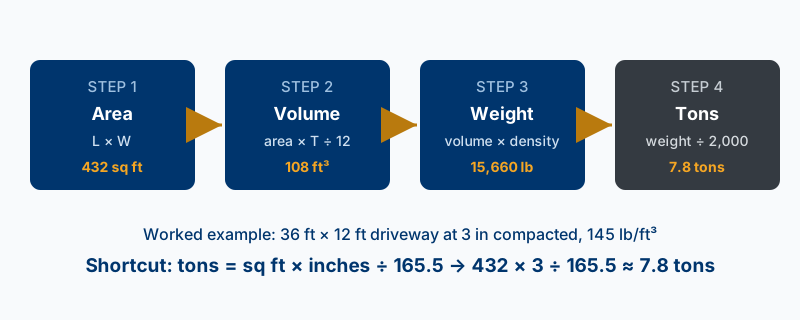
| Area (sq ft) | length (ft) × width (ft) |
| Volume (ft³) | area × thickness (in) ÷ 12 |
| Weight (lb) | volume × compacted density (lb/ft³) |
| Tons | weight ÷ 2,000 |
Chained together with the standard 145 lb/ft³ planning density, this collapses into a one-line shortcut:
| Shortcut | tons = sq ft × inches ÷ 165.5 |
The constant 165.5 is just 24,000 ÷ 145 — the unit conversion (12 in/ft × 2,000 lb/ton) folded into the density. If your plant quotes a different compacted density, recompute it: 24,000 ÷ your density.
Worked example: 36 × 12 ft driveway at 3 inches
| Area | 36 × 12 = 432 sq ft |
| Volume | 432 × 3 ÷ 12 = 108 ft³ |
| Weight | 108 × 145 = 15,660 lb |
| Net tons | 15,660 ÷ 2,000 = 7.83 tons |
| Order (+5% waste) | 7.83 × 1.05 ≈ 8.2 tons |
| Shortcut check | 432 × 3 ÷ 165.5 ≈ 7.83 tons ✓ |
The reverse formula: tons to coverage
Sometimes you start from the other end — a supplier offers a fixed load, or a quote states a tonnage, and you want to know how far it goes. Flip the shortcut around:
| Coverage | sq ft = tons × 165.5 ÷ inches |
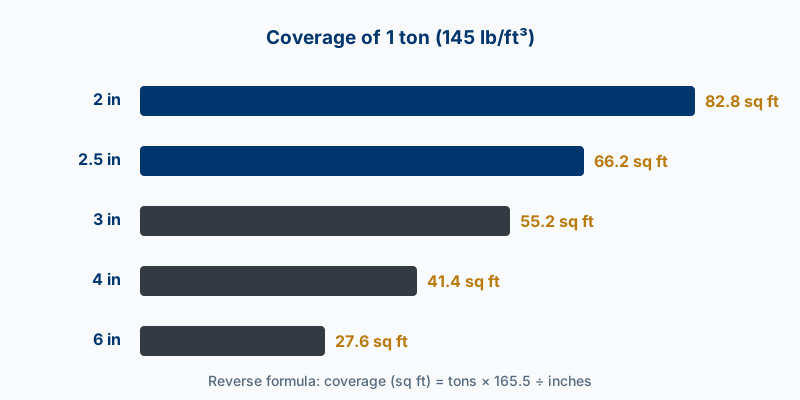
So a 12-ton load at 3 inches covers 12 × 165.5 ÷ 3 ≈662 sq ft. The full picture at common thicknesses:
The square-yard form: 110 LB/(SY·IN)
Many US contractors and specs quote the formula in square yards:tons = square yards × inches × 110 ÷ 2,000. The 110 lb per square-yard-inch is the same density said differently — 110 lb ÷ 0.75 ft³ = 146.67 lb/ft³ — so both forms agree:
| Project | 600 sq ft = 66.7 SY at 3 in |
| Square-yard form | 66.7 × 3 × 110 ÷ 2,000 = 11.0 tons |
| Shortcut form | 600 × 3 ÷ 165.5 = 10.9 tons |
The 0.1-ton gap is the rounding between 146.67 and 145 lb/ft³ — well inside any waste allowance. Use whichever form your supplier quotes in.
The metric form
Outside the US the same chain runs in meters and tonnes, with no ÷ 12 and no ÷ 2,000 to remember:
| Volume (m³) | area (m²) × thickness (mm) ÷ 1,000 |
| Tonnes | volume × density (kg/m³) ÷ 1,000 |
| Example | 50 m² at 50 mm = 2.5 m³ × 2,323 kg/m³ ≈ 5.8 tonnes |
2,323 kg/m³ is simply 145 lb/ft³ converted (multiply by 16.018). Our calculators do all arithmetic in metric internally, so the US and Metric views of a project always agree — see the methodology.
The four variables that change the answer
- Density — compacted unit weight, not loose mix. The 135/145/150 lb/ft³ presets are planning inputs; your plant's mix design is the real number. See the density guide.
- Thickness — compacted thickness, after rolling. Every extra inch adds a third again at 3 in: 432 sq ft goes from 7.8 tons at 3 in to 10.4 at 4 in.
- Waste allowance — the formula gives net tons; order quantity adds waste, starting around 5% for clean rectangles and rising for irregular shapes.
- Ton definition — US short ton (2,000 lb) vs metric tonne (2,204.6 lb). Twenty short tons are about 18.14 metric tonnes, a difference of about 1.86 tonnes.
Why different websites give different answers
If two asphalt calculators disagree, it is almost never the arithmetic — it is the defaults. Different sites assume different compacted densities, some use loose-mix weight, some round thickness up, and a few silently add waste. That is why every default on this site is visible and editable: you can match our inputs to your supplier's numbers and watch the result move. The FHWA hot-mix asphalt construction manual(reviewed September 21, 2026) shows how widely compacted unit weight varies with materials, and the Asphalt Institute engineering FAQ(reviewed September 21, 2026) is a good cross-check for mix terminology.
Common formula mistakes
- Forgetting ÷ 12 — thickness in inches must convert to feet before it touches square feet, or the answer comes out 12× too heavy.
- Mixing square yards and square feet — the 110 LB/(SY·IN) form needs square yards (sq ft ÷ 9), not square feet.
- Using loose density — the formula needs compacted density; loose mix straight from the truck is lighter for the same volume.
- Skipping waste — net tons is what lands in place, not what you order.
- Rounding mid-chain — keep full precision until the final tonnage.
How to use this in the calculators
The asphalt calculator runs this exact chain and shows every intermediate value, so you can verify it against the hand math above. If you only need the area side first, see how to measure a driveway; for the full quantity walk-through with a per-100-sq-ft table, see how much asphalt do I need.
FAQ
What is the formula for asphalt in tons?
Tons = length (ft) × width (ft) × thickness (in) ÷ 12 × density (lb/ft³) ÷ 2,000. With the standard 145 lb/ft³ planning density it shortens to: sq ft × inches ÷ 165.5.
How many square feet does a ton of asphalt cover?
At 145 lb/ft³, about 83 sq ft at 2 inches thick, 55 sq ft at 3 inches, and 41 sq ft at 4 inches. Coverage = tons × 165.5 ÷ inches.
Is the 110 LB/(SY·IN) rule the same formula?
Yes — 110 lb per square-yard-inch equals 146.67 lb/ft³, so it is the same density in different units. Both forms give the same tonnage within rounding.
Does the formula work for millings or cold patch?
The chain is the same, but the density changes — recycled millings compact differently from fresh hot mix. Use the material-specific defaults in the millings calculator rather than 145 lb/ft³.
How accurate is the shortcut constant 165.5?
It is exact for 145 lb/ft³. If your plant quotes a different compacted density, replace it: constant = 24,000 ÷ your density. At 150 lb/ft³ the constant becomes 160.
Ready to run your own numbers? Open the asphalt calculator for tonnage and truckloads, or the asphalt cost calculator to carry the result into a budget.